London’s Dream Palaces
Cinema is at a crossroads. As TVs get bigger and better and the cathode ray monsters are replaced with their smug HD-ready offspring, you can now enjoy a cinematic experience in your own home. Why go to the cinema when it’s cheaper and more comfortable to stay on the sofa? You can pause the film to get a cup of coffee, or rewind if you didn’t quite catch what was said. And there won’t be a guy next to you tapping away on his mobile or grazing loudly on popcorn (and if there is, for some reason, you can ask him politely how he got into your house).
Lovefilm, the UK version of Netflix, has changed the game too. For a few pounds a month you can get DVDs through your letterbox or stream them on your computer. And those less troubled by the laws of the land (insert News of the World joke here) can simply download the latest films for free.
But London’s best cinemas can offer something different, something worth paying for. I’m not talking about gimmicky 3D, but a social experience in awe-inspiring surroundings.
In the golden era of the 1930s and ’40s, it was the buildings themselves, not just the films, that provided the escapism of ‘going to the pictures’. The Architects’ Journal of 1935 notes that cinema had become ‘the twentieth century’s distinctive contribution to building types, just as the railway was the nineteenth century’s’.
The art-deco cinemas of Oscar Deutsch (the O and D of ‘Odeon’) emerged all over London. Other designers took inspiration from across Europe and beyond. The Palace in Southall boasted a Chinese-style pagoda pantiled roof, fierce dragon’s head finials and lavish colours. The Carlton in Islington opted for an Egyptian approach, whilst Regent Street’s Plaza recreated a little piece of Italy.
Sadly, there are now fewer than 150 cinemas in London and almost all of the ‘dream palaces’ of the last century have been knocked down or converted into lifeless bingo halls. Gone are the architectural marvels, replaced by bland multiplexes – completely devoid of character or charm.
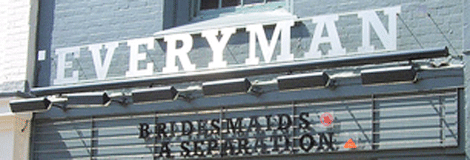
But there are still a few genuinely special cinemas left. From the luxurious decor of the Everyman cinema in Hampstead, to The Phoenix in East Finchley, which dates back to 1910 and now has listed building status. My personal favourite is The Electric in Notting Hill, where the stunning interior is worth the admission price alone. Just don’t ruin it by seeing Transformers 3.
Image by Jim Linwood courtesy of Flickr
You may also like


About Post Author