
Ed Ruscha: 50 Years of Painting
From his student paintings to grandiose cinematic panoramas, the Hayward Gallery’s retrospective celebrating 50 years of Ed Ruscha’s paintings, charts his experimentation with word and image, inspired by graphic design, Americana and the visual noise of the every day.
Ruscha’s early paintings use typography to encase noise in art. The bold uppercase statements on garish backgrounds, like Noise, make one word shout across a room while Scream represents the temporality of sound as, just like the noise soon disappears after it leaves the body, the word itself also disintegrates into the background.
Hurting the Word Radio also literalises how easy words can be manipulated on canvas; clamps tighten themselves around the curves of the letters, asking whether distorting the image of a word can maybe distort the meaning of the language itself?
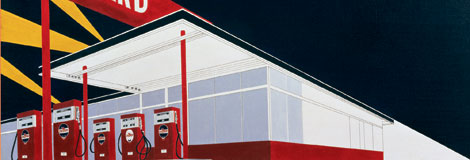
Ruscha similarly disturbs meaning without words; the generic American gas station of Standard Station, is carefully constructed between architectural ruled pencil lines however, in a matter of centimetres, the predictable and the recognisable is destroyed in the companion painting, Burning Gas Station, as the eye follows the identical line and soon discovers the same station now ablaze.
In the 1970s, Ruscha shows his experimentation isn’t just conceptual, deviating from oil painting to egg yolk in Sand in the Vaseline. The sign’s warnings: ‘These paintings have vulnerable surfaces’, seem to capture the essence of Ruscha’s aesthetic; if meaning can be so easily washed away, why should we concrete the everyday in oil-paint?
Ruscha’s paintings unpick the connection between image and word, forcing us to bring our own interpretation and emotion to the painting. It’s impossible to ignore the idyllic background image while reading the huge words in Not a Bad World Is It?, then in Hi Honey, we are literally lured over by a carrot on a stick to read a tiny, almost missable, printed message. One of the beautiful City Lights series, Wen Out For Cigrets, picks out and celebrates a simple overheard phrase from one of the hundreds of voices that reside in the ribbons of blurred street lights that lie behind the text.
Ruscha embraces these emotive connections of word and image in The End, where ominous gothic print is trapped between two frames, as if saying the end is coming…but not quite yet. Similarly, the mountain paintings juxtapose awesome nature with the mundane phrases of life. We want our everyday to be connected with this breathtaking beauty but something just doesn’t fit. They belong to different worlds…or words.
But Ruscha forces such paradoxes onto the same canvas, all the while dangling any promise of definiton on that preverbial carrot on a stick. If a picture could speak a thousand words, judging by this amazing look back through his work, Ruscha makes sure words can speak a thousand images, and just as loudly.
Ed Ruscha: Fifty Years of Painting is on until 10 January, 2010, at:
Hayward Gallery
Southbank Centre
Belvedere Road
Borough
Southwark
SE1 8XX
Tickets £10 (Concessions £6). Open daily 10am – 6pm, late nights Friday until 10pm.
Image: Standard Station, 1966. Courtesy Private Collection© Ed Ruscha 2009. Photography: Paul Ruscha
You may also like


About Post Author
