
After Hours: Science Uncovered
I remember standing behind the glass windows of the labs at the Natural History Museum – the scientist enclosure if you will – sweaty palms pressed against the glass, a child greedy for knowledge, in the hopes of catching a glimpse of something being discovered or Eureka’d in front of my eyes.
But this was only a few months ago. I know, I know, I work in the arts, science is the enemy that takes all the whimsical creativity out of life by categorising and proving everything with formulae – but I’m not ashamed to admit I enjoy getting my geek on at a good science museum from time to time. I just love dinosaurs.
Last night, I found myself back at the scientist enclosure, only to find it deserted – the scientists had been let loose. While I would like to imagine this was caused by a Jurassic Park style glitch that unlocked the doors releasing the scientists into the real world, in reality it was part of After Hours: Science Uncovered, a one-off event for European Researchers’ Night, which saw museums in 200 cities around Europe open their doors to the public.
The event aims to bring science into the public domain, dispelling the preconceptions so often attributed to scientists and proving that they are, in fact, just like us. But just in case, they were given nifty bags declaring ‘I’m a Scientist’. Alright, no need to brag…
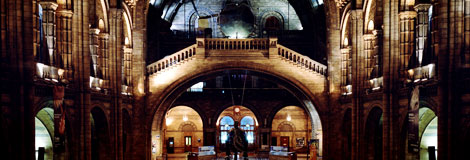
One of my favourite things about the Natural History Museum is the building itself, the grandiose Grade 1 listed building was the perfect backdrop to an evening where usually forbidden behaviours at museums – touching, questioning those more intelligent than you and drinking alcohol – were positively encouraged. No red wine near the exhibitions though – they haven’t gone completely crazy.
Invoking the naughty school girl in me, I wandered through the Mammals corridor, face-to-face with lions and tigers and polar bears, glass in hand, considering how possible it would be to hide in the museum after after hours… Back in the main hall, past the diplodocus, I chatted casually about the new technological developments in the identification process of wasps with a member of the Palaeontology department before heading to the European Research station to learn about Scratchpads; the Facebook for scientists that allows you to share knowledge, upload images and collaborate on research with other scientists without ever leaving the lab.
In the Science Bar, we sat and conversed with a real life scientist, picking a topic of conversation from the menu. Our plat du jour was whether science can ever be solely for entertainment or whether it has to be for monetary gain or advancing technology. As the only arts type at the table I felt like I held my own with our cancer researcher and diagnostic expert companions, arguing that people tend to forget science was borne from curiosity – a fact our official scientist friend wholeheartedly agreed with stating his strand of science is purely for entertainment, working out the how-what-and-why’s of the world.
Conversation moved on to why Katie Price’s novels (35 of them, apparently) consistently make the bestsellers list but science books, that actually have something of worth to say, remain in the bargain bins. Strangely, even our exemplary meeting of minds could not reach an answer for that one.
With torch-lit dinosaur tours, forensic talks and the opportunity to get hands-on with ancient specimens (not the scientists), After Hours was a fantastic alternative night out. We can only hope they hold another one soon… and that they do not display the drawing we were asked to make of what scientists look like to us. Namely a crude sketch involving test tubes, glasses and Y-fronts… The dinosaur made me do it.
After Hours: Science Uncovered took place on Friday 24 September at:
Natural History Museum
Cromwell Road
South Kensington
SW7 5BD
Image: Copyright: Natural History Museum.
You may also like



About Post Author

Is this post the reason the queues were around the corner today?